
The Creation Process:
From Linen to Glazing
The pictorial method preserved by Ária Fine Art rescues the technical rigor, artisanal patience, and pursuit of precision of the great classical ateliers. Each work is born from a methodical constructive process, executed step by step:
Linen Preparation: The process begins with the rigorous selection of pure linen (in 160g and 180g weights), which initially undergoes a wash with mild soap to remove impurities and manufacturing residues.
Stretching and Sizing: The fabric is firmly stretched onto the stretcher bars and receives traditional sizing with diluted rabbit skin glue, applied in three successive coats, with meticulous sanding between layers to waterproof and stabilize the fibers.
Application of Traditional Gesso: Over the sized base, traditional gesso is applied — composed of rabbit skin glue diluted in warm water, titanium dioxide, and calcium carbonate in specific proportions —, totaling four coats with rigorous sanding between each application to ensure a leveled surface.
Earthy Imprimatura: The prepared surface receives a lean imprimatura with pure linseed oil and pigments (titanium dioxide and raw umber), applied with a spatula and then leveled with a brush, creating a harmonious and toned background.
Indirect Construction and Layers: The painting is developed through the indirect method in a style similar to Flemish painting, structured strictly under the principle of fat over lean, respecting drying times between each stage.
Modeling and Glazes: Initially, the drawing is done in soft charcoal. Consequently, in lean layers with turpentine, linseed oil, and pigment, the shadow values are painted with earthy tones. After this stage dries to the touch, warm lights are built up using titanium dioxide and yellow ochre in lean layers, firmly establishing the structures of form and the values of light and shadow. Subsequently, the work advances to base colors in warm tones and then base colors in cool tones. Finally, the artwork is finished with translucent glazes using thickened linseed oil (stand oil), allowing light to pass through the layers to confer optical depth, a serene atmosphere, and an enduring connection to the traditional craft.
Oil on Linen
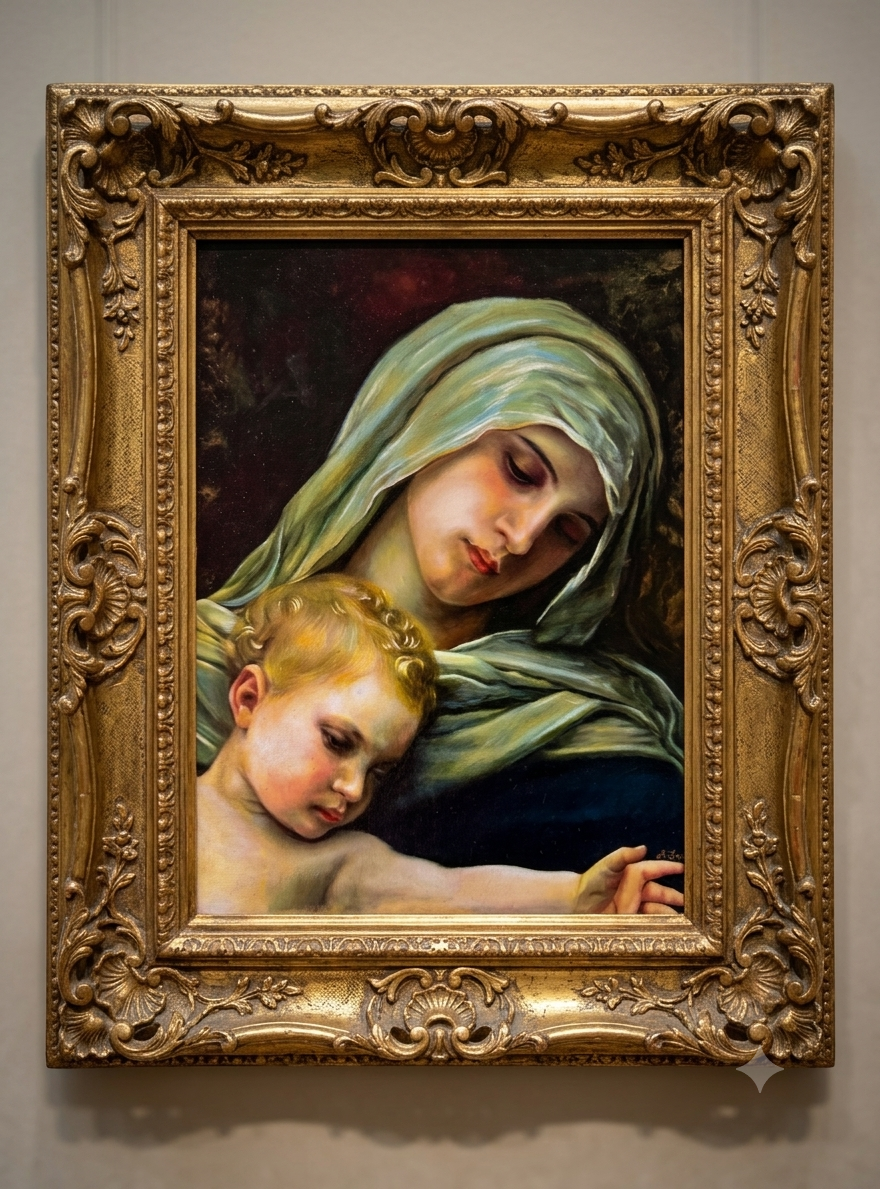
Reinterpretation of William-Adolphe Bouguereau's work, La Vierge à l'Enfant, 1888. Oil on canvas, direct painting technique method, 40cm/30cm, Antônio Márcio do Amaral & Jean Elias Soares Fagundes, 2024 (illustrative frame).